
Driving in rain: a practical guide to doing it safely
Summarize this article with
Rain requires more margin: check tyres and wipers, switch on dipped-beam headlights, slow down smoothly and increase distance. If water prevents you seeing or the road becomes dangerous, stop away from the carriageway in a suitable place.
Driving in rain is not about gripping the wheel harder and waiting for the shower to pass. Water changes grip, lengthens braking distance, fills the windscreen with reflections and can hide potholes or puddles. It also changes how other people drive: a lorry can throw up a curtain of water, a pedestrian may appear with a reduced field of view and a queue can form before you see it.
The useful response is to create margin before you need it. That starts when you decide whether the trip can wait, continues with a simple vehicle check and shows up as smoother driving. Wet conditions reduce the room available for a mistake. This international guide concentrates on visibility, vehicle preparation and practical decisions; lighting rules, minimum tyre tread and temporary road restrictions still need checking for the place where you drive.
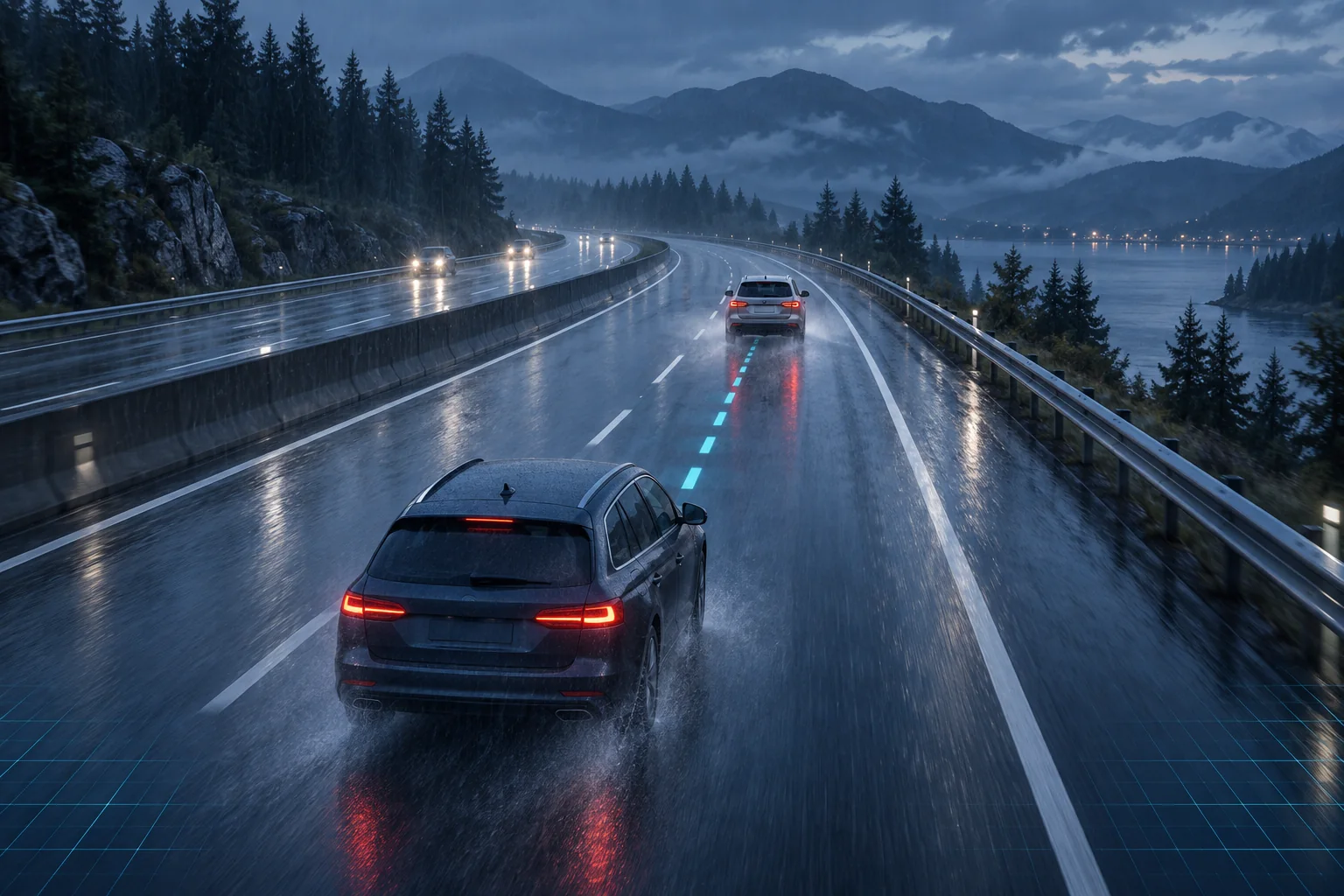
What changes when it starts raining
The first difficulty is grip. A film of water appears between tyre and road, making every acceleration, brake input and turn less effective. The first drops can mix with dust and oil collected on the surface; a road that looked dry therefore behaves differently as a shower begins. There is no universal speed that guarantees safety: tread and tyre pressure, the amount of water, asphalt type, visibility, traffic and road condition all matter.
The second difficulty is seeing. Rain reduces the contrast of road markings, creates reflections from lights and fogs the windows. Water thrown by other vehicles can remove your references for several seconds. On a secondary road, a bend with vegetation or a crest can hide standing water; on a dual carriageway, spray from a heavy vehicle can cover the windscreen just as you overtake.
The third is deciding with less time. When you see a queue, obstacle or stopped vehicle late, a short gap leaves little room to correct. Safe wet-weather driving is about anticipation: look farther ahead, increase the separation from the vehicle in front and accept that the journey may take longer.
| What you notice | What it may mean | Prudent decision |
|---|---|---|
| The wipers cannot clear the glass | Rain is exceeding your ability to see | Slow without a sudden brake and find a safe place to wait |
| The vehicle ahead leaves a cloud of water | You have less visibility and reaction time | Increase the gap or wait before overtaking |
| The steering feels light over standing water | The tyres may be losing contact with the road | Hold the trajectory and avoid braking or turning sharply |
| Water is flowing across the road | It may hide depth, damage or a current | Do not cross water you cannot assess; choose another safe option |
| The windscreen is fogging | Interior visibility is falling | Direct ventilation at the glass and do not continue until you can see clearly |
Before setting off: decide whether today is a driving day
Not every rainy spell means cancelling a trip, but a bad forecast changes preparation. Check the national meteorological service and the road operator before loading the car. Look for a forecast covering the route and arrival time, not just the weather at home. Record official closure information and identify a place to wait before a flood-prone section. A morning check cannot guarantee conditions several hours later. Do not drive through floodwater or past a road closure because a navigator still offers that route.
Ask yourself three simple questions:
- Can I delay departure? If the trip is not urgent and there is a warning for intense storms, flooding or very low visibility, waiting may be the best decision. Do not let a departure time become an inflexible commitment.
- Do I know the route and its decision points? Identify service areas, exits, tunnels, mountain passes, low-lying sections and reasonable alternatives. The aim is not to memorise every kilometre, but to know where you can stop without improvising on the carriageway.
- Am I fit to drive? Rain demands more attention. If you set off already sleepy, stressed, in pain or rushed, you will have less room to react. Delay, change drivers or split the route.
A quick vehicle check
Do the check with enough time to solve a problem, not on the first shoulder of the trip. Inspect blades, demisting, lights and the condition of the windscreen, and arrange professional attention for any brake or tyre defect. A short trip does not need a workshop inspection each time, but it does need the items that directly affect seeing and stopping. Replace a blade that smears the glass before the next downpour.
| Item | What you can check while parked | When to stop improvising |
|---|---|---|
| Tyres | Manufacturer pressure with cold tyres, cuts, deformation and visible wear | If there is damage, vibration, falling pressure or badly worn tread, consult a garage |
| Wiper blades | That they clear without bands, skipping or a film that reflects lights | If they do not clear the viewing area, replace them before the route |
| Windscreen and mirrors | Clean glass inside and out, with nothing blocking the view | If a crack or dirt prevents seeing, solve it before setting off |
| Lights | Dipped beam, position, brake, indicators and fog lights as appropriate | If a lamp fails or a headlight is very dirty, do not leave it for the road |
| Demisting | Ventilation and heated rear window working | If you cannot keep the windscreen clear, reconsider departure |
| Washer fluid | Enough in the reservoir and correctly spraying jets | Refill with a suitable product; do not rely on a little water from a petrol station |
Correct pressure is not the number you remember from another car or an app. Check the vehicle label or manual, and check the spare wheel if you carry one. NHTSA tyre guidance explains the importance of using the vehicle manufacturer’s cold inflation pressure. That maintenance principle is useful internationally; its page is not the law for every destination. With a load, the manufacturer’s recommendation may change, so read the specific indication before a heavily loaded trip.
Prepare the cabin
Place the seat, mirrors and phone before starting. A posture that makes you stretch or look over the steering wheel becomes more uncomfortable after an hour in rain. Keep a dry cloth somewhere the passenger can reach, never in a compartment that makes the driver search while moving. Set the ventilation so it can be directed at the windscreen and decide what sound or instruction you will hear without handling the screen.
If you travel with children or pets, secure every item. A bag on the floor or loose object can move under braking, and rain should not add another task for the driver. A passenger can change the route, read an alert or check an incident; when travelling alone, those actions wait for a safe stop.

The first minutes of rain
When rain begins, act before its intensity peaks. Switch on dipped-beam headlights to see and be seen, activate the wipers and adjust ventilation. Reduce pace progressively by lifting off and braking gently when necessary. Do not wait for the car to slide before increasing distance: leave space while you still have clear references.
The right speed is the one that lets you keep the trajectory, see the road and stop within the space you can observe. The signed limit remains a maximum, not a mandatory speed in every condition. A straight road with light rain may allow a different pace from a section with standing water, poor visibility and dense traffic. If you cannot see the lines or the lights of the vehicle ahead clearly, slow further and look for the next safe exit or area.
To measure separation, choose a fixed point and count the time from when the vehicle ahead passes it to when you reach it. In rain, extend the interval clearly. This is not a magic number: it helps you check that you are not following too closely and leaves room for a smooth manoeuvre. If traffic does not allow the gap, reduce pace and do not overtake out of impatience.
How to steer, brake and turn
Smoothness is a control tool. Accelerate progressively, brake before the bend and turn without sudden movements. The car needs the tyres for three tasks: keeping the trajectory, transmitting acceleration and braking. If you demand all three at once on water, margin decreases. Anticipating the bend and arriving at a moderate speed leaves more grip available for correction.
Look far ahead and choose the cleanest path, but do not enter another lane to avoid a puddle you cannot assess. Running tracks can collect water near ruts, joints or changes in slope. The road line is a reference, not proof of a dry surface. In a bend, do not fix your eyes on the obstacle you want to avoid: identify a safe trajectory and hold it with small corrections.
Overtaking and meeting large vehicles
Overtaking in rain adds several risks: you cross more water, may lose the lateral reference and receive spray from the vehicle you pass. Do not do it to gain a few seconds. Before starting, check that you can see far enough, the surface appears uniform and you can return without cutting the gap. Increase wiper speed before the spray and return calmly without closing in on the vehicle.
When passing a lorry or bus in the opposite direction, its water spray may cover the windscreen. Keep the wheel steady, maintain a prudent speed and avoid reacting with a hard brake when visibility disappears for a moment. If the splashes repeat or the road is too busy, leave more space. The aim is to have time to regain visibility, not to gain position.
Lights and glass
Use lighting that makes your vehicle visible without dazzling others, and keep lamps clean. Check the destination’s specific rules for headlights and fog lights: an automatic switch or daytime running lights alone may not provide the lighting needed in poor visibility. Do not leave fog lights on after conditions improve. Main beam can reflect back from spray, so more brightness is not automatically more useful visibility.
Fight interior mist with ventilation directed at the windscreen and the heated rear window when needed. If cleaning the glass requires looking away or releasing the wheel, stop safely or ask the passenger to help. Do not open a window expecting to solve mist that prevents you seeing: the important decision is to restore visibility before continuing.
Aquaplaning: what to do when the car loses support
Aquaplaning occurs when the tyres cannot move water away and lose part of their contact with the road. It may feel like very light steering, a delayed response to a turn or a brief sensation that the car is floating. Risk increases with speed, water depth, incorrect pressure or insufficient tread. You cannot always see a pool's depth before entering it.
If you feel that loss of support:
- Hold the wheel firmly and avoid a sudden change of direction. A large steering input can become a sharp turn when grip returns.
- Ease off the accelerator progressively. Allow speed to fall smoothly.
- Avoid abrupt braking. The aim is to regain contact without adding a harsh input. If a collision is imminent, use the vehicle’s braking system as required; do not disable safety systems.
- Correct gently when grip returns. Reassess speed, lane position and distance, and look for a safe stopping place if conditions remain unsuitable.
Do not test aquaplaning in a flooded area. These steps reduce surprise but do not make a pool safe. If the road is flooded or a current crosses it, do not guess the depth: stop at a safe point and follow official instructions.
Puddles, flooding and intense storms
A small puddle can hide a pothole, displaced cover or deeper water than it appears. If you can avoid it without a dangerous manoeuvre, do so early and within your lane. If you cannot assess the depth, do not cross it out of obligation. In low areas, underpasses and roads near waterways, conditions can change quickly even when it is not raining over your car.
A storm that reduces visibility requires distinguishing between slowing down and stopping the journey. While you can still see references, slow smoothly and increase separation. If the wipers cannot clear the glass, leave the road at a suitable place and wait. Do not turn the shoulder into a rest stop: choose an exit, service area, authorised car park or other space that does not leave you exposed to traffic. If an emergency forces you to stop, follow signs and traffic-service instructions.
On a flooded road, do not follow another vehicle as proof that yours can cross too. Weight, height, tyres and current change the response. An alternative route can be longer and still be the only reasonable choice. Check official conditions before resuming and remember that a community app can supplement information but cannot confirm by itself that crossing is safe.
Town, secondary road and motorway
In town, rain adds pedestrians with umbrellas, bicycles, motorbikes and crossings that are hard to see through spray. Slow before junctions and leave lateral space. Do not use the puddle beside the kerb as a depth reference: it may splash someone or hide a drop. In roundabouts, enter more slowly and avoid changing lanes during a correction on a slippery surface.
On a secondary road, crests, leaves, mud and tight bends appear with less warning. Watch the signs, do not cross into the opposite direction to improve a line and adapt pace before the bend. If rain falls on roadworks or dirt on the carriageway, assume grip may be irregular for several kilometres.
On a motorway, other vehicles' speed and spray make anticipation decisive. Keep a wide gap, avoid travelling beside another vehicle for a long time and watch distant brake lights. If you receive a warning about a queue or water on the road, do not look at the phone: lift off, leave more space and respond to signs. The screen can wait for a stop.
After the shower: the road does not return to normal at once
The end of rain does not mean the risk has disappeared. Water can remain in ruts, on bridges, at tunnel entrances and in shaded bends. Leaves, mud and washed-down dirt change grip even when the sky clears. Keep the same smooth driving for several kilometres and return to normal speed only when visibility returns and the surface is clearly stable.
After leaving a very wet area, notice any vibration, new noise or unusual steering feel. Do not diagnose a wheel hit by a pothole or displaced part by accelerating to test it. Enter a safe place and inspect visually; if the problem continues, request assistance. If the brakes have been exposed to a lot of water, use them gently and let their response return before needing a hard stop, without testing them through risky manoeuvres.
Visibility can also worsen at dusk, when wet asphalt reflects more light. Clean the glass at a stop and check that the blades have not left a film. The return route deserves the same preparation as the outward route: a familiar road may now have puddles, debris or a new incident.
An example of a decision on the road
Imagine leaving Zaragoza for Valencia. The first kilometres have light rain and good visibility. You check the lights, keep a generous gap and follow the route. Before a more intense section, the windscreen starts to fog and heavy vehicles throw up water.
The answer is not to keep the same speed because the destination is still the same distance away. Direct ventilation at the glass, increase wiper speed, lift off and let the gap to the vehicle ahead open. If water makes the road impossible to distinguish, take the next safe exit or authorised area. There, check the official warning and decide whether to wait, change route or continue when conditions improve.
That pattern works for almost any trip: notice the change, buy margin, take a simple action and review the decision once parked. Rain rewards that sequence because it prevents a small loss of visibility from requiring a large manoeuvre.
Final checklist for driving in rain
Before setting off, check:
- I have checked the weather and incidents on the route.
- The tyres have the stated pressure and no visible damage.
- The blades clear the glass and there is enough washer fluid.
- Lights, heated rear window and demisting work.
- Seat, mirrors and navigator are adjusted while parked.
- I know where I can stop without being exposed to the carriageway.
- I have allowed time to drive more slowly and rest.
- I know that traffic alerts supplement signs and do not replace emergency services.
Frequently asked questions
What should I do if rain stops me seeing the road?
Reduce speed progressively, increase distance and look for a safe place away from the carriageway where you can stop until visibility returns. Do not stop in a lane or continue by inertia when you can no longer make out the road.
How should I react if I feel aquaplaning?
Hold the steering wheel firmly, keep your trajectory, ease off the accelerator gently and avoid braking or turning sharply. When grip returns, correct the trajectory smoothly.
Which lights should I use when it rains?
Use dipped-beam headlights to see and be seen, and check the wipers, heated rear window and demisting before setting off. Lights do not replace adapting speed or following signs.
The international road safety guide brings together more habits for preparing the car, keeping distance and avoiding distraction. If an alert tells you about water, a crash or a queue, use it as a reason to increase margin and follow road signs, not as permission to make decisions with the screen moving.
Official sources and limits of this guide
The UK Highway Code’s adverse-weather guidance explains reduced grip, spray and easing off when water makes steering unresponsive. Those physical safety principles inform this guide; UK lighting laws on that page are not presented as international requirements. NHTSA tyre guidance supports the cold-pressure check. For the trip itself, consult the destination’s weather service and road operator, follow closures and signs, and obtain professional advice about any vehicle defect.