
Driving at night: a practical guide to seeing and being seen
Summarize this article with
At night you need more room to see, interpret and react. Check lights, glass and mirrors before leaving, use the proper lighting without dazzling anyone, slow down when your headlights do not reach far enough to anticipate and stop as soon as fatigue or drowsiness appears.
Driving at night changes the amount and quality of information reaching the driver. The road may look clear, but edges, pedestrians, bicycles, animals and obstacles appear later. Other vehicles' lights add reflections and glare, while darkness makes a bend or crest hide what is ahead for longer.
Night driving changes what you can detect and how soon you can react. A road that feels familiar by day can conceal a pedestrian, bend or stopped vehicle after dark. This guide helps you prepare the car, choose a speed that fits the visible road and decide in advance where to stop. It applies to international travel without assuming one country’s headlight law, driving side or speed limits. Check those requirements separately before departure.
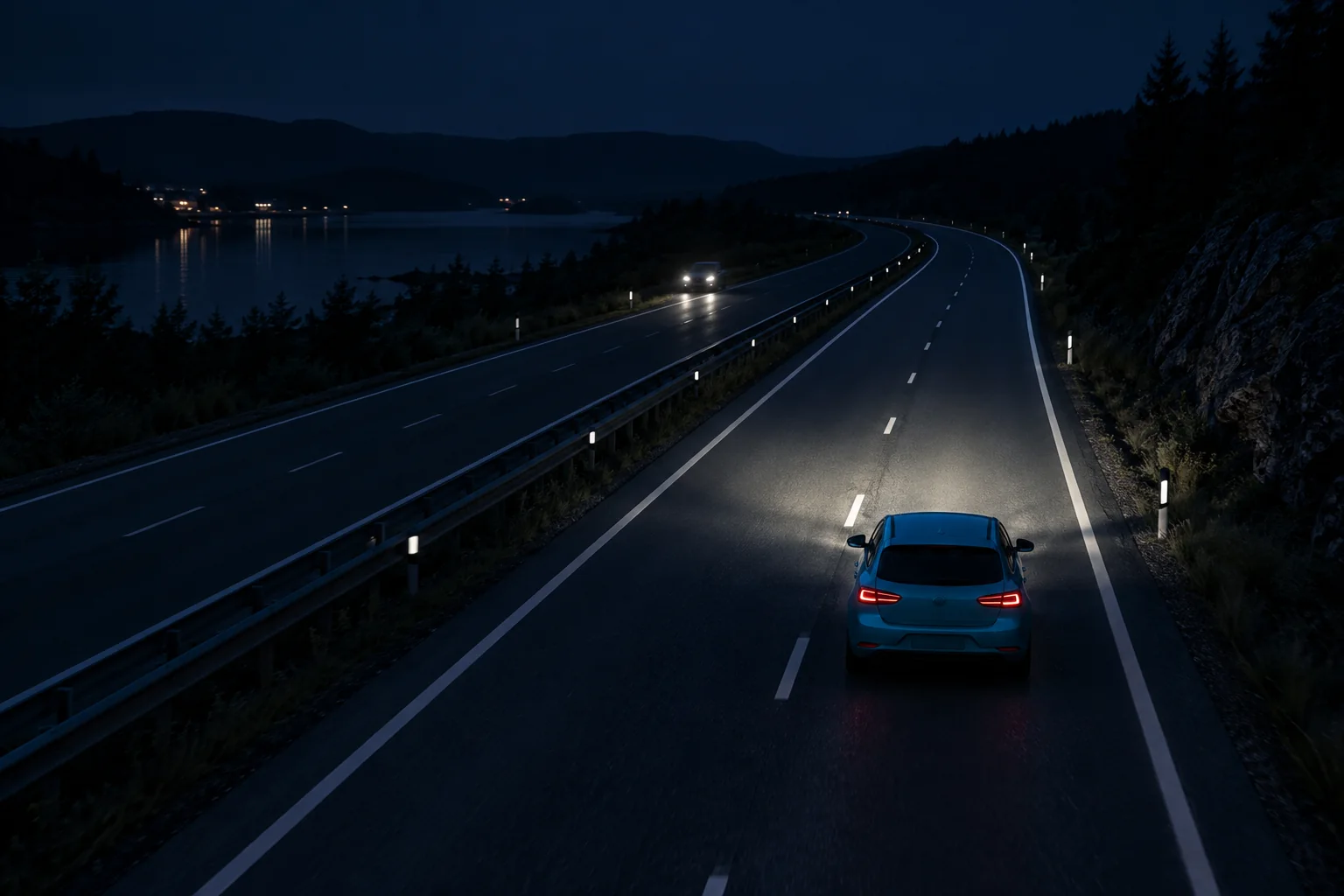
The transition starts before darkness
The most demanding stretch does not always begin when the sky is already black. At dusk, contrast falls, shadows lengthen and other drivers may delay switching on lights. Dawn creates a similar problem: it may seem bright enough, but shaded areas, fog or rain can still reduce visibility. Prepare lighting early and judge the actual conditions. A clock time cannot tell you whether an unlit vehicle will be visible against the road behind it.
Before starting, look at the windscreen from inside and outside. A film of grease that is barely noticeable in daylight can multiply reflections from streetlights and oncoming vehicles. Clean the mirrors as well, check that nothing hangs from the interior mirror and adjust the seat so you can look far ahead without hunching. If the glass is misted, clear it before moving.
Night encourages a false sense of an empty road. There may be less traffic, but a vulnerable road user without visible lighting stands out much later. On a secondary road, the room you have to stop depends on how far your lights reach and what the surface reflects, not on whether you know the route.
Check the car before leaving
Make the night check simple and repeatable: inspect the lights, clean lamps and glass, set the mirrors and confirm that the headlamp setting suits the load. Do it while stationary, before you are in a hurry. If you are borrowing or renting a car, locate the manual lighting switch and main-beam control before leaving the collection area. Familiar controls are worth more than guessing at symbols after dark.
| Check | What to look for | Decision if it fails |
|---|---|---|
| Dipped and position lights | Both sides work and are not covered in dirt | Fix the fault before starting a dark route |
| Main-beam lights | They switch correctly and return to dipped beam | Do not depend on them if the control or lamp does not respond |
| Brake lights and indicators | Other people can anticipate your manoeuvres | Ask someone to check the rear of the car |
| Fog lights | You know when they switch on and the warning goes off when no longer needed | Read the manual if you cannot distinguish the controls |
| Windscreen and lamps | No film, mud or drops scattering the light | Clean them before leaving; do not solve it with a dangerous stop |
| Mirrors | The field of view is adjusted without unnecessary blind areas | Readjust while parked, not during the first kilometres |
| Tyres | Manufacturer's pressure and no visible damage | If there is vibration, a cut or pressure loss, contact a workshop |
A heavy load in the boot can change the vehicle's angle. If the car allows headlight-height adjustment, use the position specified by the manufacturer for that load. A beam that is too high bothers oncoming drivers and the driver ahead; one that is too low shortens the information you receive. Do not correct the setting by eye on a dark road. If the beam is poorly aimed or causes glare, solve the problem in a suitable place.

Use lights without bothering others
Use the lighting required locally and appropriate to the conditions. Dipped headlights generally provide useful illumination without the reach of main beam; daytime running lights alone may not illuminate the rear of the vehicle. Use main beam only when permitted and when it will not dazzle another road user. Dip before meeting traffic or shining into the mirrors of the vehicle ahead. Automatic systems still need supervision around bends, crests, cyclists and poorly lit vehicles. Before crossing between countries that drive on different sides, check the manufacturer’s instructions for headlamp adjustment or an approved adaptation. Do not invent a permanent beam pattern with improvised tape.
If a line of vehicles appears, return to dipped beam even if the road becomes harder to see. Safe driving means accepting the shorter range and reducing speed if necessary, rather than keeping main beam to preserve the same pace. In an urban area, public lighting is not permission to forget the other lights or people crossing.
Fog lights are intended for reduced-visibility conditions and must be used according to those conditions and the rules. Do not turn them on to make a clear night brighter. Rear fog lights can be very uncomfortable for the vehicle behind when fog, heavy rain or snow no longer justify them. Switch them off as soon as visibility allows you to drive without them.
Automatic lighting helps but does not interpret every situation. A sensor may leave the car without the lighting you need in a tunnel, at dawn or in heavy rain, depending on the vehicle and surroundings. Check the dashboard and the road. No automatic mode replaces checking whether you can actually see and be seen.
Glare: a sequence lasting a few seconds
Glare can come from an oncoming vehicle, a badly positioned mirror, a bright screen in the cabin or a streetlight reflected in the windscreen. When it happens, the common mistake is to stare at the source to judge when it will pass. That fixation delays the recovery of your vision.
Use a simple sequence:
- Keep a steady path. Do not make a sharp turn towards the edge when glare removes your references.
- Slow smoothly. Increase the room you have to respond while considering traffic behind.
- Look away from the light source. Use the safe edge and markings of your own lane without staring at the verge or drifting towards it. The relevant side depends on the road and driving direction.
- Do not retaliate with main beam. A contest makes vision worse for both drivers.
- Stop if necessary to avoid proceeding blind. Keep the manoeuvre controlled, signal as appropriate and do not drive farther simply to reach a preferred stopping place when you cannot see the road.
The interior mirror's night position reduces the reflection of headlights behind you. Use it without losing the function of the exterior mirrors. If the outside mirrors send an intense light back at you, change their angle only when stopped; while moving, keep control of the lane.
Speed: let the headlights reach your decision
The posted limit is a maximum conditioned by the road and vehicle. At night, the appropriate speed also depends on the real reach of your lights. If the surface is wet, there is fog, bends are tight or traffic is approaching, that reach becomes shorter. You must be able to stop for something that enters the area you can see, not for something you hope is not there.
Try this check on a safe straight section: identify a distant reference, notice how long it takes to reach it and ask whether you could stop if a dark object appeared there. You do not need to calculate while driving; notice whether your pace forces you to look too close. If signs, reflectors or lane markings arrive before you have time to read them, slow down before the next stretch.
The gap to the vehicle ahead should be larger at night because a braking vehicle may first appear as two small red lights. On a dual carriageway, do not follow closely to use the car ahead as a guide. That removes your view of the road, reduces response time and may make your own lights shine into its mirrors.
On a two-way road, leave lateral room and do not move towards the centre to “see better”. An oncoming vehicle may be hidden behind a bend, crest or dark vegetation. The centre line and edge markings help keep you in your lane; they are not an invitation to accelerate as soon as you see no traffic.
City, dual carriageway and secondary road
In the city
Urban lighting creates many bright points and not all announce a hazard. On a street with shops, a pedestrian may emerge between parked cars; on an avenue, a bicycle may remain outside the cone of vision until the last moment. Slow down before crossings, junctions and roundabouts. Look towards places where someone could appear, not only at the middle of the lane.
Reflections from shop windows, traffic lights and signs can make a person in dark clothing blend into the background. Do not use the phone to confirm a direction at the last second. If you have taken the wrong street, continue to a safe place and reorient yourself while stopped. At night, an improvised manoeuvre to avoid missing an exit puts people who did not expect the change at risk.
On a motorway or dual carriageway
Keep the appropriate lane, watch brake lights several vehicles ahead and leave room before overtaking. A vehicle changing lanes may first appear as a reflection or flash. Check the blind spot in the usual way and signal early. Do not remain beside a heavy vehicle longer than necessary.
Service and rest areas are better decision points than the shoulder, provided you can reach them safely. If your vision deteriorates, slow as much as necessary, including stopping: do not continue without being able to see just to reach an exit. If drowsiness or a fault appears, seek the first suitable place you can reach without increasing the risk and request help if you cannot continue.
On a secondary road
Night removes information that seems permanent by day: the depth of a bend, a rural junction, a tractor with insufficient lighting or an animal near the edge. Slow before bends, do not follow the centre line to find a wider line and be ready for vulnerable road users. A reflective sign helps you orient yourself but does not reveal everything outside the headlight range.
In wooded areas or near fields, alternate your gaze between the path and the sides without sweeping so far that you lose the lane. If you see an animal, do not swerve into the opposite lane. Slow, keep control and brake progressively according to the available distance. If animals appear repeatedly, increase your margin and report the location when stopped through the appropriate channels.
Night and weather conditions
Darkness and rain compound each other: water reflects headlights, spray hides the road and markings lose contrast. In fog, main beam may reflect from droplets. Use the proper lighting, slow down and increase the gap. Do not drive without seeing the road to find a better place; reduce speed as necessary, including stopping, and call for help if immobilised in a dangerous position.
Wind can disturb the vehicle near an exposed bridge, tunnel exit or large vehicle. Darkness makes some warning cues harder to interpret. Slow before the exposed section, maintain a steady grip and avoid abrupt corrections. Check the official weather service and road operator before departure, especially for bridge restrictions affecting high-sided vehicles. A forecast for the departure city may not cover a mountain pass later in the journey.
Fatigue, eyesight and breaks
Sleepiness is not confined to the early hours. NHTSA’s fatigue guidance emphasises adequate sleep and the limited effect of short-term measures. Music, an open window and a colder cabin do not clear a sleep deficit. If keeping your eyes open or maintaining attention becomes difficult, stop safely and reassess the trip. A quiet road still requires a fully alert driver.
Plan a break before the dark stretch, not when you are already nodding off. At a stop, walk a little, drink water and assess whether you can continue. If your eyelids are heavy, memories of the stretch are incomplete or errors repeat, sleep or change drivers. If attention does not return, end the journey. The guide to fatigue and drowsiness explains how to recognise those signals and share a long trip.
A passenger can help read signs, look after children and choose a stopping place, but should not give contradictory instructions every few seconds. Agree before leaving on a short word that signals a break and a rule: any call, message or route change is handled with the car stopped.
What to do if a light fails during the trip
A failed bulb, system warning or lamp that no longer illuminates properly changes the safety of the trip. Do not continue to the destination just to avoid stopping: slow down, hold your path and look for an area, service station or exit where you can stop without exposure. Check from outside only if the place is safe and the fault can be inspected without touching hot parts or moving close to traffic.
If the car vibrates, loses power or shows a red warning, treat it as a mechanical incident, not only a lighting problem. Signal, leave the carriageway when possible and follow the procedure for what to do in a roadside breakdown. Night is a poor time to repair a car on a narrow shoulder.
Bends, junctions and crests
Main beam can make a straight look long, but it does not show what is behind a bend. Enter bends at a speed that lets you keep the lane without harsh braking. Look towards the exit when you can see it, while keeping attention on the near edge and lights that may appear ahead.
At a crest, the field of view ends just where a slow vehicle, animal or queue may be hidden. Lift off before reaching the top and do not overtake if you cannot see the entire stretch. On a two-way road, a solid line, prohibition sign or lack of visibility is enough reason to wait, even when you see no approaching headlights.
Rural junctions and entrances from tracks may have little lighting. A vehicle leaving a property may take time to show its lights; a person may cross somewhere other than the usual crossing. Slow before the junction, cover the brake and look for movement at the sides. Do not treat a horn or flash as permission to cross without checking.
At urban intersections, traffic lights and façades create sharply uneven contrast. A green light does not guarantee that the junction is clear. Check pedestrians, bicycles and vehicles that may ignore priority. If glare hides a sign or you cannot read it, stop where permitted and resolve the doubt before continuing.
Passengers, luggage and controls inside the car
Night increases the temptation to place a screen on the dashboard, review an itinerary or look for clothing in the boot. Leave those tasks for a stop. A passenger can read directions, but should not ask you to look at a screen you cannot safely attend to. If you are alone, follow the prepared voice route and accept an extra turn when the exit is unclear.
Interior lights matter too. A bright screen, tablet panel or torch pointed at the windscreen creates reflections and reduces adaptation to darkness. Ask passengers to dim lights and keep objects outside the driver's field of view. Do not block the mirrors or load luggage high enough to hide other vehicles' brake lights.
After a concert, dinner or work shift, plan the return with the same care as the outward journey. If the driver has been drinking, is very tired or takes medication that can cause sleepiness, choose another way home. Do not use a short stop to argue that you are ready when your eyelids are still heavy. The time saved by leaving immediately can turn into an unsafe route.
A contingency plan for the night
Before leaving, decide on three responses: if I am dazzled, reduce speed as necessary, including stopping; if sleep appears, interrupt the journey at the first safely reachable place; if a light fails or a warning appears, assess whether a separated area is reachable without increasing the risk. Looking for a better stopping place never justifies continuing without visibility.
| Situation | First action | Next reasonable place |
|---|---|---|
| You cannot distinguish the road well | Lift off and increase the gap | Exit, service area or authorised car park |
| The route asks for a manoeuvre you cannot read | Keep the lane and continue | Safe place to recalculate |
| An oncoming headlight dazzles you | Avoid staring at it and reduce speed as necessary | Stop completely if needed; seek an exit only with adequate visibility |
| A passenger needs attention | Continue to a stopping place | Area where you can check documents or the route |
| Eye fatigue appears | Interrupt the stretch before nodding off | Real rest or a change of driver |
You do not need to wait until the car is in danger to use the plan. An early stop is part of night driving, just like switching on the lights. When you resume, check whether conditions have changed and do not automatically return to your previous pace.
Night departure checklist
Before joining the road:
- I have cleaned the windscreen, rear window, mirrors and lamps.
- Dipped beam, main beam, position, brake, indicator and fog lights work.
- Headlight height matches the vehicle's load.
- Mirrors are adjusted and the cabin has no lights reflecting in the glass.
- I know an area or exit where I can stop if sleep, glare or a breakdown appears.
- I have allowed more time and breaks than for a daytime route.
- The phone, route and alerts are configured before moving the car.
- I remember that signs, officers and emergency services have priority over any alert.
Frequently asked questions
When should I use dipped headlights at night?
Use the lighting required in the country and suitable for the conditions. Dipped headlights help avoid dazzling others; main beam requires a clear situation and must be dipped before it affects other road users. Daytime running lights alone may not provide adequate night lighting, particularly at the rear.
What should I do if a vehicle dazzles me?
Reduce speed as much as necessary, including coming to a complete stop, to avoid hitting vehicles or pedestrians ahead. Do not stare at the light and keep a steady path. Only look for an exit or rest area once you have enough visibility to continue safely.
How do I know when sleep makes a night journey unsafe?
Yawning, heavy eyelids, watering eyes, repeated errors or not remembering the last few kilometres are signals to stop. Leave the road at a safe place, rest or change drivers; do not try to compensate with music or cold air.
Official sources and limits of this guide
This international guide separates physical safety principles from national lighting requirements. WHO’s road-safety overview provides the broader prevention context, and NHTSA’s drowsy-driving guidance supports the fatigue section. Consult the vehicle manual for lighting controls and the destination’s official rules for required lamps and their use. For persistent glare, vision problems or sleepiness, obtain professional advice; the guide cannot assess eyesight or fitness to drive.